Sunday, March 27, 2011

Extremely bored? Follow me on Twitter

I know I said I'd never Tweet, but I've given in. Follow me: @slyoungbld

Compassionate volunteers serve hope at destitute orphanage

From the Parkville Lumimary

NOTE: For a complete photo album from the Mercy Home orphanage, click here.

BEWYA, UGANDA—The 40 minute drive from downtown Kampala south to this small village is dusty and slow, thanks to a washboard road. Mostly, the drive is a journey from the relative modernity of the capital city to a place that, even though it serves youth, is miles away from the cutting edge.

At the Mercy Home for Children, an orphanage housing 50 children 5-18 years old, being on the edge has an entirely different meaning. Though it may sound like hyperbole, the fact is that Mercy Home’s youngsters constantly live on the edge as they wonder if they’ll eat or go to school or be able to see a doctor if they get sick.

Located on a plain overlooking pretty Lake Victoria, the orphanage is run down. The kitchen, if you can call it that, is an out-building with dirt floors and a crumbling brick stove. The toilets are awful, and the walls have accumulated the dust that proliferates here. The dormitories where the kids live are habitable, though dingy.

Right now, Mercy Home has no funding. None. They’re trying to fundraise and to get some government or NGO support, but haven’t had any luck thus far. This means that from day to day, the orphanage’s volunteer administrator John Bosco Kiwanuka doesn’t know how he will feed the kids, let alone help out the youngsters who need medical or dental care. Kiwanuka said he contributes what he can, but that’s not much since he has his own household full of mouths to feed.

Because there is no funding, there is no money to pay employees. Kiwanuka said he visits as often as he can, but he also has a paying job and a family. A matron volunteers her time to stay at night babysitting the youngest kids, but has to leave during the day. Sometimes, the kids are unsupervised, breeding the potential for all kinds of trouble.

Mercy Home’s children aren’t alone in Uganda, where there are an estimated 2.5-million orphans, according to UNICEF. Uganda has 8-million kids 14 and under, so it doesn’t take a mathematician to figure out that orphaned children are an epidemic here.

Just when things looked darkest, four new volunteers recently arrived at Mercy Home, giving hope to the 50 children. Two Ugandan volunteers, Susan and Tabu, live nearby. The other two volunteers are from halfway around the world—Parkville, Missouri.

Susan has pitched in to clean up the home, and has donated much needed firewood so that the children could cook their meals. The Parkville volunteers, Barbara and Alex, have been working on clean-up, too. They have also helped Tabu to patch a road leading to the home. Barbara and Alex regularly bring beans and cooking oil so that the kids have something to eat. Barbara has sunk hundreds of dollars already into Mercy Home, spending it on foodstuffs, cleaning equipment, bleach, shovels and pick axes, etc. She’s planning to renovate the kitchen, including installing a cement floor. She has paid for one swollen-faced young man to visit a dentist, and others with malaria to see a doctor and get the medicine they need. On one recent visit, Alex, age 13, was even spotted teaching dance steps (from “Dancing with the Stars”) to a half-dozen of the orphanage’s residents.

Based on what I saw, I think Susan, Tabu, Barbara, and Alex’s biggest contribution to Mercy Home is bringing hope. It was incredible to see how the whole place brightened up when Alex and Barbara arrived amid a swarm of hugging, smiling orphans.

Despite the hope, the reality is that Barbara and Alex will be heading back to Missouri in May. When they’re gone, what will become of Mercy Home? To her credit, Barbara has raised over $3500 for the orphanage, including $2000 from one generous Parkville donor. Barbara is carefully rationing the donations so that they stretch as far as possible. That’s great, but the need for more funds, and sustainable funding, is pressing and unending.

I’m unbelievably proud of Barbara, my wife, and Alex, my son. Like Barbara. I lay awake at nights worrying about how to continue helping Mercy Home’s orphans live a decent life.

NOTE: If you are interested in helping, contact Barbara Youngblood at:
byoungblood1231@yahoo.com

Wednesday, March 23, 2011

Goodbye Mbale; Hello Gulu; Geeky Video Posted

Just finished fantastic seminar in Mbale...a very receptive, energetic group of journalists. (For photo album of the Mbale seminar and the Kampala Peace Summit discussed below in the previous post, click here.)

I have also edited/posted a short video from this seminar. If you're terminally bored, click here to see this monstrosity.

Headed to Gulu tomorrow to present at a seminar designed to instruct local officials on how to deal with the media. Should be interesting, or at least something different.

Sunday, March 20, 2011

"Winter" welcomed with open arms

A Ugandan friend has been joking that winter has arrived here. It is a few degrees cooler, but still in the upper 70's every day. It's cloudy much of the time, and has rained quite a bit during the last few weeks. Still, it's a nice break from the sunny, hot days of January and February.

Ugandans lay foundation for peace

From the Parkville Luminary

KAMPALA, UGANDA—At the birth of my baby last week, I swelled with pride as I swatted the newborn on the tush and waited for that first, healthy cry.

We named the baby the African Peace and Reconciliation Society (APRES). The healthy cry took the form of passionate discussions that took place at the meeting where APRES came into this world. (Photo--Drafting goals, guidelines at the Peace Club Summit)

I’m not sure if you can really call me the father, since all I had was an idea to call together Ugandans to support and promote peace. APEC’s real fathers and mothers are those everyday citizens who decided to organize themselves into Peace Clubs. As part of our 10-month, USAID/US State Department sponsored Peace and Electoral Journalism project in Uganda, we convened community leaders in 20 locales and encouraged them to come together to support and encourage journalists to practice responsible reporting that promotes peace and reconciliation. In 14 towns, the Peace Clubs took root, and are working to make their communities more harmonious places.

In Kampala, representatives of seven Peace Clubs from across Uganda recently met at what we called a Peace Summit. Our goal at this summit was to create a national Peace Club organization, an umbrella group that would unite the 14 operating Peace Clubs.

As the summit unfolded, Peace Club representatives gave encouraging reports that indicated how their efforts helped to prevent violence during the just-completed elections. “No politician used radio for excessive incitement (of violence),” reported a representative from Soroti in the east. The rep from Kabale in southwestern Uganda said his Peace Club was “instrumental” in preventing election violence by educating voters and politicians and holding media accountable. Reps from Gulu and Jinja similarly trumpeted the efficacy of their efforts at promoting peace and encouraging reconciliation.

It’s enough to make a father, make that uncle, proud.

After the initial reports, the real business of the summit began, starting with naming the new organization and giving it a mission, a structure, and goals. APEC’s goals are indeed laudable, and include fostering traditional shared peaceful values; advocating for and implementing peace education programs; developing curricular materials to be used in civic education efforts about peace; equipping local communities with conflict resolution skills; and promoting good governance and accountability, especially when it comes to issues of peace. To add to this ambitious agenda, the summit participants committed APEC to expanding beyond Uganda’s borders into Kenya and perhaps South Sudan, hence the word “African” in the organization’s name rather than “Ugandan”.

The summit concluded by creating a proposed structure for APEC as well as discussing how to make the organization financially self-sustaining. This will be a tall challenge, but I’m confident in their ability to find at least some funds to carry on their activities.

As the summit wound down, APEC Moderator Moses Mugabi picked up on my metaphor, telling the gathering that APEC is “our baby” and that it’s up to the group’s membership to nurture the infant.

Inspiring those present, Mugabi concluded by saying, “We must lead from the front, and be the very examples of what it takes to be a volunteer.” Based on what I’ve seen from Mugabi and his peers, they will indeed by exemplary volunteers and peace advocates.

When we started the Peace Journalism project in Uganda last June, the Peace Clubs idea seemed to me an afterthought—a tertiary effort that looked good on paper. I never really thought anything would come out of it. I have never been so wrong, or so happy to admit my miscalculation. The only thing that peace lovers here in Uganda needed was an idea. Judging by their energy and commitment, one can’t help but be optimistic about the ongoing prospects for peace here in the great lakes region of Africa.

Thursday, March 17, 2011

Odds, Ends, and One Final Election

The last election of 2011 in Uganda was held Monday as Kampalans chose a new mayor. This was a rescheduled voting date, since the initial mayoral election was cancelled after a few hours because pre-stuffed ballot boxes were discovered. Voting was peaceful. The candidate whose name appeared on the pre-checked, stuffed ballots lost, by the way. Poetic justice?

The boy and I recently visited the fantastic Uganda Wildlife Education Center in Entebbe. It's part zoo, part home to distressed or rescued animals. Lots of fun, especially the troupe of moneys who inhabit the UWEC's parking lot! (Click here for photos).

Just six weeks left in Uganda, which hardly seems possible. On April 29, it's off to Cape Town, South Africa for two weeks of teaching (Univ. of Cape Town) and relaxation.

Saturday, March 12, 2011

Rotary Clubs unite to feed students in Arua

From the Parkville Luminary

Note: To listen to two radio reports about this story, click here.

ARUA, UGANDA—In July 2009, a famine had students at Ociba Primary School clamped tightly in its jaws. On my visit there, the place seemed listless, and strangely empty, even though hundreds of kids milled about. Like the hot air in this dusty place, you could almost breathe in the famine, the suffering, and it would scar your insides.

I have walked through some of the world’s most awful slums, fought back tears while visiting with victims of war, and spent an overcast, drizzly day at a former Nazi concentration camp. Nothing left me as shaken and depressed as my 2009 visit to the Ociba Primary School.

Thus, it was with palpable reservations that I recently returned to Ociba. What I discovered was that today, thanks to two Rotary Club chapters half a world apart, life is very different for the school’s 1,019 students.

The turnaround at Ociba began in the fall of 2009 in, oddly, Parkville, Missouri, where the local Rotary club heard a radio story from July 2009 about how a famine was ravaging school kids in remote northwestern Uganda. In the story, the kids, in their own voices, described how they were hungry, and ate perhaps only one small meal per day. At that time, School Administrator Ezale Kennedy estimated that about 100 youngsters a day missed school because they were too hungry or sick from malnutrition to attend. He said some even skipped school to scavenge or steal food. Even when they did attend, Kennedy said the students couldn’t concentrate on the simplest tasks. The school had no lunch program, and students went home for lunch. The problem, however, was that for many, there was no food at home, either. The famine that year at the school merely reflected the hunger in the community, where at least 26 famine victims were confirmed dead by a local official.

Upon hearing the famine story, Parkville’s Rotarians quickly raised $1000, which was sent to their Rotary brothers in Arua to start a school lunch program. The Arua Rotary Club received the money, and used it to buy bulk foods (beans, grain for porridge, cooking oil). Then, using their own resources, the Rotarians here bought and donated cooking utensils and a stove to Ociba.

The school lunch program was launched during the three month spring term (February-April) in 2010, and was a huge success, thanks not only to the Rotarians but to a handful of parents who were also able to make small contributions to the lunch program. The $1000 went a long way, paying for three months of school lunches for almost 1,000 kids.

Kennedy gushes when asked about the effects of having lunches at school, even if it was for just three months so far. He noted that absenteeism dropped to almost zero while the quality of the students’ school work soared. The kids I talked to agreed, noting that they now feel like they can conquer any academic challenge.

Arua Rotary Club President Alex Matua said the lunch program showed the students that people cared, thus giving the kids “hope for a better life.”

The worst of the famine ended last year, although hunger continues to stalk these impoverished kids. Kennedy said 40% of Ociba’s students still don’t get enough to eat. Hunger is a problem throughout Uganda, where 9-million (28% of the population) people are “food insecure” (un.org).

Though the first installment from Parkville ran out last spring, Parkville’s Rotary has recently donated $1000 more for school lunches. Of course, the school’s boosters hope that this latest donation won’t be the last, and indeed Parkville Rotary’s Don Breckon, who spearheaded the original aid package, said he is looking for ways to expand the funding for the school.

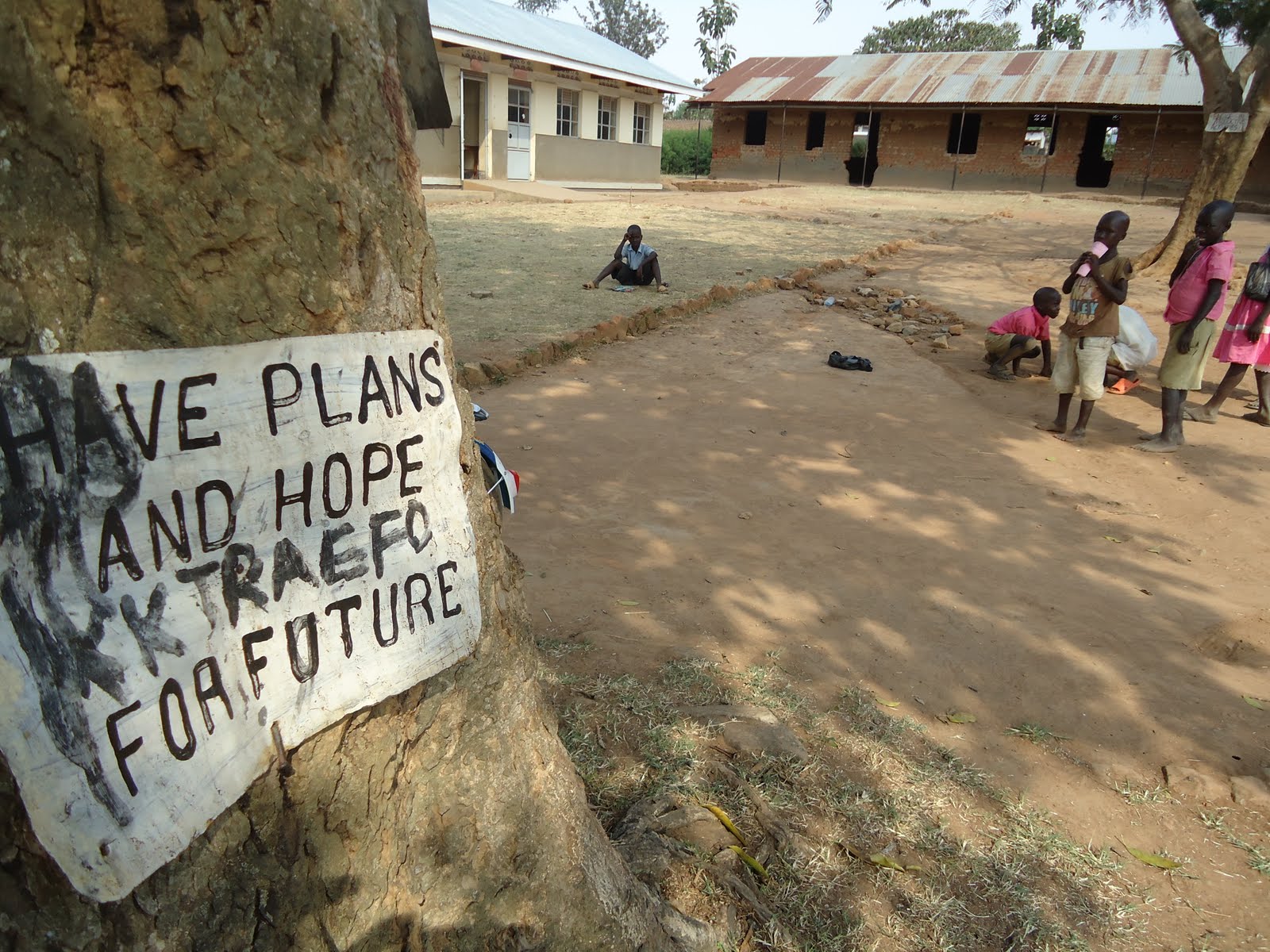
It’s a new sense of confidence that made Ociba School feel so different this time. I could see it in the kids faces, and even read it on a hand-made sign posted in the school’s spacious courtyard—“We have plans and hopes for the future.” I noticed the same sign in 2009, but thought it seemed sadly unrealistic. Today, thanks to two Rotary Clubs, hopes and plans seem within reach for Ociba’s students.

For photo album of Ociba school, click here.