Monday, July 27, 2020

War, toxic media culture underscore need for peace journalism in Yemen
Imagine a highly polarized media environment where media focus exclusively on the alleged misdeeds and even atrocities committed by the other side. Media stoke hatred by dehumanizing the other side. In this environment, there is no middle ground, only biased reporting and propaganda, leaving the public with a distorted picture of reality.

No, this is not the United States.

This is the media environment in Yemen, as described in an article by The Atlantic Council. Yemen is saddled not only with this toxic media culture, but with an especially brutal war that has, according to Human Rights Watch, sparked the “world’s largest humanitarian crisis, with 14 million people at risk of starvation and repeated outbreaks of deadly diseases like cholera.” (Human Rights Watch)

Against this backdrop, I conducted a peace journalism seminar last Thursday and Friday for 13 journalists from Mukalla in Southern Yemen, an area which has not been spared the ravages of war. According to one of the seminar’s organizers, in Mukalla,  “a half million people live in extreme poverty, and in the city streets beggars are searching for food in garbage, while sewage has floated in open drains, causing environmental pollution and spreading many diseases.”
In a normal year, due to the ongoing war, the seminar would have been conducted in person in a neighboring country like Oman or UAE. But we know 2020 is anything but normal, and thus, the seminar was held via Zoom.
I presented information about the fundamentals of peace journalism. The principles of giving voice to the voiceless and rejecting ‘us vs. them’ narratives were especially salient for the participants. We discussed if peace journalism is widely practiced in Yemen. According to the journalist participants, it is not. We also reviewed the Atlantic Council’s assessment of Yemeni media, and they agreed with the journalist who told the Atlantic Council that “polarization in Yemeni media has never been this high. The problem is that there is no room for a middle ground. On one hand, Houthis (one of the warring parties) allow press only if it is biased in favor of them, as does the Yemeni exiled-government. All that you have in Yemen now is propaganda and each side can support you, only if you abide by their propaganda.”

Asked to present tips on how Yemeni media could practice peace journalism, the participants shared ideas like listening to all parties; double checking sources; including discussions of peace; interviewing “everyone”; concentrating on truth and not rumors; and developing more training in peace journalism techniques. The participants also agreed that they have a vital role to play when it comes to curating social media for their audiences--to “check sources, look for the truth, and listen to all parties,” in the words of one participant.

The seminar closed with break-out session conversations about Peace Radio, a new community radio station dedicated to peace and peace programming that will begin broadcasting later this year in Southern Yemen. The journalists were excited about the potential of Peace Radio, believing it will help in changing perceptions about the conflict. The participants said Peace Radio will  be an especially useful platform for giving voice to all parties in the conflict, and for giving a voice to the voiceless, especially women.

I closed the seminar by pledging my support and advice as Peace Radio moves forward. I’m hopeful that when the fog of Covid-19 finally lifts, I’ll get a chance to meet my Yemeni colleagues in person.


Wednesday, July 22, 2020

Is peace journalism possible during a war?
Is peace journalism possible in the middle of a war?

This will be the first of many questions I’ll be asking reporters from Mukalla, Yemen tomorrow and Friday during our Introduction to Peace Journalism seminar, to be presented on Zoom. I’ve seen peace journalism succeed in many post conflict situations, but am curious to hear the journalists’ viewpoint on the role of PJ in building peace during an ongoing war.

For the uninitiated, there has been a brutal war raging in Yemen for the last five years. (See this BBC primer for details). The war has led to arguably the world’s worst humanitarian disaster. According to Human Rights Watch, “The UN considers Yemen to be the world's largest humanitarian crisis, with 14 million people at risk of starvation and repeated outbreaks of deadly diseases like cholera. This crisis is linked to the armed conflict. The Saudi-led coalition's restrictions on imports have worsened the dire humanitarian situation.” 

In Mukalla in Southern Yemen, one of the seminar’s organizers described his city as one where “a half million people live in extreme poverty, and in the city streets beggars are searching for food in garbage, while sewage has floated in open drains, causing environmental pollution and spreading many diseases.” At least there is currently no fighting in the Mukalla region.

Against this discouraging backdrop, can peace journalism make a difference? I’ll have a better answer in a few days.

UPDATE
As I was posting this, I got a message from my Yemeni seminar organizer that is a reminder of yet another problem in the country—poor Internet. My friend writes,  “We are fine but unfortunately ,due to  the depression (storm) off the eastern coast of Yemen, the (communications) cable (for the) AL Mahra Governorate was cut off, which led to the suspension of internet service…I hope that this sudden and urgent matter does not delay the training date .Now 14 of 16 participants  all of them do not have the internet, including me, so I called  my friend in India to send this  message.”

I will keep you all posted.

Tuesday, July 14, 2020

Virtual PJ seminars to serve Yemen, Sudan, and KC
As it became clear that Covid-19 was pretty much going to cancel or postpone everything, I was seized with the awful thought that, at least until the end of the pandemic, I would be unable to continue my peace journalism work.

I was disabused of this notion in about 15 minutes.

While it’s true that I’ve had a bucket full of postponements, it’s equally true that I continue to work on peace journalism projects remotely. For example:

Yemen peace journalism seminars—I will be giving a series of two peace journalism seminars to journalists from Mukalla, Yemen in late July. I’m working with the Peace Journalism Platform there as well as a group of journalists who are in the process of launching a community radio station simply called, Peace Radio. I expect about 20 participants on Zoom. As you know, Yemen has been devastated by war since 2015. I’m hoping that our PJ project may in some small way contribute to a more peaceful country.

Sudan peace journalism project—The project, done in conjunction with the U.S. Embassy in Khartoum, will begin with a three day virtual workshop in early August. I’ll be going over the basics of PJ, including coverage of refugees and terrorism, both important topics in Sudan. It’s hoped this Zoom seminar will be followed up by one or several face to face workshops in Khartoum. Of course, that depends on Covid.

Kansas City Media Literacy Project—I received a Citizen Diplomacy Action Fund Rapid Response award from the U.S. Department of State to fund a project titled, “Media Literacy for Students: Lessons from Covid-19.”

The project will take place in the greater Kansas City area. It will utilize virtual seminars and projects to educate and inform students about our society’s information challenges as illustrated by disinformation about Covid-19, civil rights protests, and other current issues. The first virtual seminars will be held in September 2020, followed by the creation of a student-produced magazine and podcast discussing and analyzing media. The project will culminate with a Zoom media literacy summit in January, 2021.

Stay tuned to this space for details about each event.

Monday, June 29, 2020

Harvard event spotlights vital role of narratives
The vital role of narratives was highlighted yesterday by an august panel in a Zoom conference titled, “Grassroots Advocacy and Media Portrayals of Race, Gender, and Protests,” sponsored by several Harvard University-affiliated organizations.

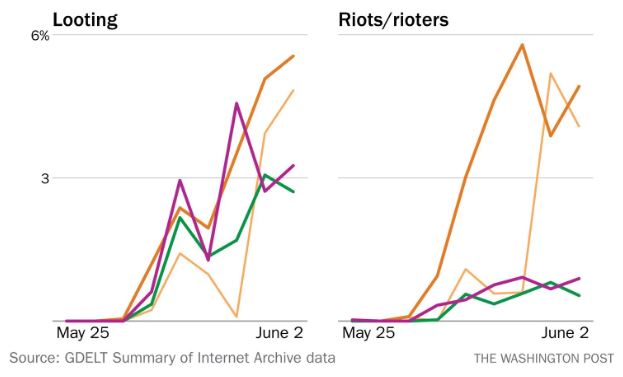
I discussed partisan media narratives in the coverage of the recent George Floyd protests. See chart below. My presentation concentrated on three prominent divergences in conservative vs. liberal media narratives that related to depiction of violence, the portrayal of police, and coverage of Antifa.

As I discussed violence, no one in the audience of 70 was surprised to learn that Fox News used the terms “riots” or “rioters” five times more than CNN, or that Fox discussed looting 25% more than CNN. I also illustrated how the “rioters or protester” narrative was displayed on newspaper front pages, the best of which (Kansas City Star, Minneapolis Star Tribune) spotlighted the 99% who were peacefully protesting, while the least responsible (Chicago Tribune, New York Post) sensationalized and spotlighted the violence.

I then presented a small study I recently conducted that looked at narratives about police in the media. I searched four news outlets, two conservative and two liberal, for the terms “police brutality” and “police systemic racism.” Unsurprisingly, the term “police brutality” was used much more by liberal media (292 combined mentions between May 25 and June 2 in the New York Times and Washington Post Blogs vs. 37 mentions during the same period at washingtonTimes.com and the Wall St. Journal). As for “police systemic racism,” the study showed 70 combined mentions in the New York Times and Washington Post Blogs, vs. just 13 combined mentions at washingtontimes.com and the Wall St. Journal.


My presentation then discussed Antifa, Fox News’ favorite fantasy. Two different studies showed Fox playing up Antifa (six times more mentions than on CNN, for example), while exaggerating the purported threat. In reality, I said, the FBI found no evidence that Antifa had anything to do with the violence that accompanied some of the recent protests.

Once I laid out the partisan media narratives, I offered peace journalism as a way to improve this coverage, including reporting counternarratives that show different perspectives on protesters and the police; reporting on “them” with respect and empathy; and giving peacemakers a more prominent voice.

Co-panelist New York Times best-selling author (“All Souls: A Family Story from Southie”) and Northeastern University lecturer Michael Patrick Macdonald also emphasized the importance of narratives. He spoke about the importance and role of personal narratives in healing and the struggle for social justice. Macdonald believes social movements are best led by victims and through, at least at the outset, peer support networks. He said, “Movements begin with the telling of stories” and helping people to reclaim their own stories. Certainly, this reflects peace journalism’s call to give a voice to the voiceless, and to tell counternarratives about marginalized groups.

Social activist Vincent Bish, former operations director for Slack for Good and Obama administration appointee, talked about media stigma, or narratives, about those who have been incarcerated, and the importance of changing that narrative—offering a counternarrative, in PJ parlance. His Slack for Good initiative works to place formerly incarcerated persons in tech jobs by combating “social redlining” that denies  opportunities to those who have been imprisoned. One lesson Bish has learned as an activist is that “no one side is unequivocally good.” This is a valuable lesson, I believe, for journalists, especially those who engage in reflexive hyper-partisanship.

Rachel Brown Pittman, president of the United Nations Association of the U.S., spoke about her group’s grassroots advocacy in encouraging U.S. support and leadership for the United Nations. She said UNAUSA encourages its members to be “vocal and visible” in the media, and to blog, write op-eds, and otherwise actively engage on social media. As peace journalists, Pittman’s presentation should encourage journalists to reflect on offering counternarratives that illuminate the scope and efficacy of the UN, as opposed to the typical media narratives that feature only UN dysfunction.

The event was sponsored by Harvard University Kennedy School Women in Power Conference and Harvard’s UNAUSA and Students vs. Pandemic groups.

Monday, June 22, 2020

A letter to Fox News on their George Floyd coverage

Dear Fox News:

Your coverage of the unrest following the murder of George Floyd has crossed the line from your usual polemical, partisan, irresponsible “journalism” into inflammatory disinformation that could potentially incite violence. 

To paraphrase the take down of another demagogue (Joseph McCarthy) whom you would have no doubt supported: Fox News, have you no sense of decency?

One example of your indecency is your distorted, mendacious reporting and commentary about Antifa, a tiny anti-fascist protest movement (it’s too loosely constituted to even be called an organization) that has sometimes had violent encounters with right wingers and neo-Nazis.

Antifa is your favorite bogeyman. A study shows that from May 27 to June 10, “Fox News programs have mentioned Antifa more than 325 times, per TVEyes. Fox Business: 173+ times. Antifa has come up 67+ times on CNN and 88+ times on MSNBC.”

The truth is that Antifa poses little or no threat. According to the Washington Post, when the group tried to gather nationally, they topped out at a few hundred. On CNN, Historian Mark Bray, who has studied the leftist groups, agreed. He said, "You can see that when these groups in major cities mobilize, they don't get more than a couple hundred people…”

In addition, Antifa had nothing to do with the violence during the recent protests. The FBI found “no evidence that the American militant anti-fascist movement Antifa was involved in violence that erupted during national protests over the death of George Floyd.” Further, a Reuters “examination of federal court records related to the charges and social media posts by some of the suspects and interviews with defense lawyers and prosecutors found mostly disorganized acts of violence by people who have few obvious connections to Antifa or other left-wing groups.” Reuters looked at federal charging documents related to the protests and found “no violent acts are alleged at all” that are attributed to Antifa.

When you weren’t scaring your viewers with a false Antifa narrative, you frightened them with distorted reporting and commentary that emphasized violence over legitimate, peaceful protests and the legitimate reasons behind those protests. A GDELT study  (chart, right) showed that Fox reports used the terms “riots” or “rioters” five times more than CNN, and your reports discussed looting 25% more than CNN. And yes, you discussed Antifa six times more than on CNN.

The result is that your deliberately distorted and demonstrably false narratives have created an atmosphere of irrational fear, a fertile ground into which seeds of disinformation have been planted on social media. Thanks to Fox and fake social media posts, terrified gun-toting small town residents in the Western U.S. have gathered to defend themselves against an Antifa invasion –an invasion, of course, that never came, and will never come. (See recent, excellent articles in the New York Times and Buzzfeed. This is the alt right’s “waiting for the Great Pumpkin” moment, the difference being that Charlie Brown and his friends weren’t armed with AK-47’s. If Fox had reported the truth about Antifa, perhaps the good citizens of small town Montana, Oregon, and Idaho wouldn’t have been so quick to take up arms and contemplate violence.

Fox News, you can and must be better. Start with more honest coverage that does less pandering and more informing. Take my advice from Peace Journalism Principles and Practices, and report on “them” (the “other side”) fairly, respectfully, and with empathy; and report about the invisible causes and effects of the unrest, and not just the visible violence. You must report contextually in a way that reflects that 99% of the protesters were peaceful. Also, report counter-narratives that provide a different perspective on the protesters, the police, and the community (this means avoiding stereotypes like all cops are brutal or all protesters are violent thugs); and report with reconciliation in mind--discuss how healing can occur and what needs to happen for it to begin.

Fox, if you don’t get better, it’s inevitable that you and your allies spreading social media disinformation are going to eventually have blood on your hands, since it’s inevitable that one of your deluded viewers hopped up on Sean Hannity and Tucker Carlson wades into a crowd of protesters and starts using the assault weapons you love so much.

Steven Youngblood, concerned viewer