Monday, May 27, 2019

Turning violence into peace
(Dungiven, Northern Ireland)- Remarkable panel discussion yesterday with violence survivors who are now peace activists. Still processing this incredible experience, held to honor recently murdered journalist Lyra Mckee. More details to follow in a few days.

Media and reconciliation in Northern Ireland
(Belfast, Northern Ireland)-Should the media play a role in reconciliation? This key question was on the front burner at Friday’s peace journalism workshop at the George Mitchell Center for Global Peace, Security, and Justice at Queen’s University-Belfast.

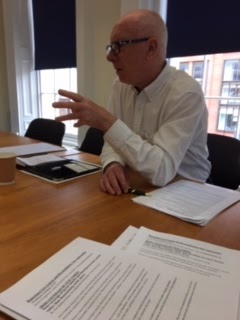
The session began with an overview of the elements of reconciliation, followed by a discussion of what role if any media should play in reconciliation—a particularly salient issue here in Northern Ireland, which is still healing 21 years after the Good Friday accords. I noted that peace journalism would encourage reporting that leads a productive societal discussion about reconciliation processes and issues, without taking a position on the desirability of reconciliation or advocating for any one reconciliation process. 

The journalist/participants agreed that media have a vital role to play in reconciliation. They noted several deficits in reconciliation coverage from Northern Ireland’s journalists. These include a gender bias that marginalizes women, over use of elite voices and under reporting about the marginalized and voiceless, and a lack of background and context in reports about reconciliation.

I mentioned that journalists everywhere struggle reporting reconciliation issues since they are complex and occur over many years. Journalists are geared to cover breaking news—accidents, disasters, violence. Reconciliation, in contrast, doesn’t break, it oozes.

Despite the struggles, we discussed several positive examples of reconciliation reporting in Northern Ireland including The View magazine and Shared Future News online.

Friday’s session concluded with a discussion about social media as a tool for peace.

The project here in Northern Ireland is sponsored by a US Embassy-London grant. It will continue this week with public lectures and meetings with journalists. 


Thursday, May 23, 2019

Social media, reconciliation in NI
(Belfast, Northern Ireland)-How can social media be a tool for reconciliation in Northern Ireland, where the search for a lasting peace continues more than 20 years after the “troubles”?

This discussion was featured in today’s peace journalism workshop for social and online media professionals at the Mitchell Center for Global Peace, Security, and Justice at Queen’s University-Belfast.


I presented a list on how to apply social media principles for peace journalism, including using SM to fact check, to broaden societal conversations, and to connect peace journalists. The participants added two important items: 1. Use social media to seek opinions outside your ideological bubble; 2. Use social media to tag those with opposing viewpoints, as a way of engendering conversations.


We also discussed an interesting fact checking initiative directed by workshop participant Allan Leonard called factcheckNI. His perspectives on fact checking as a reconciliation tool were fascinating. He said factcheckni.org is not about changing minds, but instead seeks to engage viewers to ask, ‘Do you think that the data presented constitute a basis for investigating the accuracy of a claim?’ Leonard said he believes that enough people thinking critically about a given issue could even prevent violence in Northern Ireland.


The project here is sponsored by a US Embassy-London grant. It will continue with public lectures and workshops for journalists. 

Monday, May 13, 2019

Northern Ireland media: A Primer

As I’m making my final preparations for my Northern Ireland peace journalism project, sponsored by the US Embassy in London, I thought I’d assign the class some reading to get you up to speed on the media situation there.

First, take a look at the mainstream media in Northern Ireland. These include the Belfast Telegraph https://www.belfasttelegraph.co.uk/ and Irish Times newspapers https://www.irishtimes.com/ . It will be interesting to visit with journalists from these outlets about how they perceive their coverage, and particularly to what extent it’s colored by sectarianism and bias.

An online outlet, Slugger O’Toole-- https://sluggerotoole.com/ , “takes a critical look at various strands of political politics in Ireland and Britain. It tries to bring its readers ‘open source analysis’ from both the mainstream media and the blogosphere.”

The site is full of interesting and deeply analytical reporting about Northern Ireland. For example, in an article analyzing Derry’s central role in the dissident republican movement titled “Why Derry,” writer Steve Bradley has an interesting postscript:

“It has taken three attempts over eight months to write this article – from the time of the July rioting in Derry last year, to the murder of (journalist) Lyra McKee at Easter. What has prevented completion on those previous occasions was concern at the response it would provoke. Some will seek to dismiss this article as providing excuses for Dissident activity (it does not). Others will brush it off as just ‘Derry whinging’ (as if there isn’t sufficient weight of evidence for people there to justifiably complain). Others still just don’t want to hear the fact that Northern Ireland’s second city has been cut adrift from the rising tide of post-Troubles prosperity. But I believe that each significant outburst of Dissident activity in Derry makes the case for this article stronger, and proves that the issues and questions it raises can no longer be brushed aside…”

I’m excited that my sponsor at the Queen’s University in Belfast has arranged a workshop for me with the Slugger O’Toole staff. It will be fascinating to discuss their approach to journalism. 

Finally, take a look at a different kind of outlet called Shared Future News-- https://sharedfuture.news/ --This is “an online publication dedicated to providing news, information, and personal stories on the topics of peacebuilding, reconciliation, and diversity. Posts are published at least once weekly to an audience interested in the history and politics of Ireland and Northern Ireland. We believe that it is important to spread the news of those working for a shared future in Northern Ireland.” 

I hope to be able to arrange a meeting and/or workshop with their staff. Their approach sounds very much like peace journalism, and I’ll be interested in hearing about their successes and challenges.

I’ll be enjoying Scotland and Ireland for the next few weeks, but will be ready to plunge into Northern Ireland later in May. Stay tuned for details.

Friday, May 3, 2019

Prepping for PJ in Northern Ireland
I'm eagerly anticipating my upcoming peace journalism trip to Northern Ireland. My project, funded
Queen's University-Belfast
by the US Embassy-London, is titled, Peace Journalism and Reconciliation in Post-Conflict Northern Ireland. My partners at the Queen's University in Belfast and I are working now on finalizing the program, which will include seminars for professional journalists and university lectures.

The task of discussing peace in Northern Ireland is daunting, yes, but no less so than in other places I've been like Kashmir or South Sudan.

Stay tuned to this blog for details about the project, which begins May 22.

Peacebuilding Ambassador
As an offshoot of my duties with the Center for Global Peace Journalism, I am also active in Rotary, where I've started a new position as Peacebuilding Ambassador for my Rotary district, which consists of the Kansas City area plus roughly the northern half of Missouri.

Below is a brief column I wrote for the district newsletter introducing myself and the peace ambassador concept.

Peacebuilding Ambassador: Important, but hardly glamorous
When District Governor Elect Marc Horner asked me to be District 6040’s Peacebuilding Ambassador, I imagined that, as an ambassador, I would hobnob with glitterati, attend swanky receptions and high-brow cultural events, rub elbows with the rich and famous, and advise powerful government officials.

It wasn’t until I was stuck behind a stinky semi on my way to Jeff City for the state conference that cold reality struck.

My name is Steven Youngblood, and I am breaking in the new job of district peacebuilding ambassador. While my new job isn’t exactly glamorous, the opportunity to work with my fellow Rotarians on peacebuilding projects is nonetheless exciting.

As district peacebuilding ambassador, my duties will include:
1. Educate Rotarians and Rotary Clubs about the concepts of peace and peacebuilding through presentations (in person, via Skype) and through online resource materials;
2. Work with Rotarians and Rotary Clubs to develop viable projects that promote positive peace, conflict prevention, conflict resolution, and post conflict reconciliation both locally and globally;
3. Work with Rotarians and Rotary Clubs to locate peacebuilding grant opportunities, and serve
as a resource person during the project development and grant application process.

As my first official education duty, let me quickly fill you in on a rich peacebuilding opportunity: the Rotary World Peace Conference 2020. The conference will be held in Ontario, California Jan. 17-18, 2020. The two-day conference will have six general sessions, 13 tracks of breakout sessions for a total of 104 breakout sessions, two special dinners, a House of Friendship, and a concert. 150 expert speakers will be discussing peacebuilding issues and solutions. I am honored to be one of these speakers. You can learn more about the World Peace Conference at https://peaceconference2020.org/ .
After you’ve checked out the peace conference, I ask that you begin a conversation in your club about peacebuilding. Are there peacebuilding opportunities in your community or worldwide that you feel need to be seized? If so, let’s discuss your ideas, and work on formulating a plan or project. If your plans require grant funding, I can help with that, too. (I’m writing a Global Grant now, in part to become more familiar with the process) Finally, feel free to invite me to your club to speak about peacebuilding. This may be in person or via Skype.

If you’d like to learn more about me, my short bio is pasted at the end of this article.

Despite the dearth of champagne and lobster puffs, I genuinely look forward to working with each of you to advance Rotary’s peacebuilding mission.

Steven Youngblood Bio
District 6040 Peacebuilding Ambassador Steven Youngblood is the founding director of the Center for Global Peace Journalism at Park University in Parkville, Missouri USA, where he is a communications professor. He has organized and taught peace journalism seminars and workshops in 25 countries. Youngblood is a two-time J. William Fulbright Scholar (Moldova 2001, Azerbaijan 2007). He also was named U.S. State Department Senior Subject Specialist in Ethiopia in 2018. Youngblood is the author of  “Peace Journalism: Principles and Practices” and “Professor Komagum.” He edits “The Peace Journalist” magazine, and writes and produces the “Peace Journalism Insights” blog. He has been recognized for his contributions to world peace by the U.S. State Department, Rotary Club-Parkville, and the UN Association of Kansas City.

Wednesday, April 24, 2019

Northern Ireland media teaches lesson on responsible coverage
In any conflict or post-conflict zone, the hundreds of journalists I’ve worked with agree that they bear a particular responsibility to serve their communities by not exacerbating ongoing conflicts or re-ignite simmering ones.

Sadly, this point was driven home last weekend with the murder of 29-year old journalist Lyra McKee during civil unrest in Derry.

It would have been understandable, if regrettable, if the press in Northern Ireland had gone on a rampage after the murder, making false accusations, inflaming sectarian passions, using extreme and demonizing language, and generally pouring gasoline on the fire.

A small study of reporting about McKee’s murder shows that this did not happen, and that instead Northern Irish media actively sought to not make a bad situation even worse.

I randomly chose 15 articles* about the murder and its aftermath, and analyzed them using a content analysis rubric developed by my students at Park University and I. 8 of the 15 articles were classified as non-inflammatory journalism; 5 of the 15 showed some characteristics of inflammatory and traditional (inflammatory) journalism; and only 2 were considered traditional journalism.

One of the two traditional journalism stories was an opinion column that appeared in the Independent. Especially noteworthy was its angry tone, name calling (“dinosaurs”), and homage to the Troubles (“blood spattered past.”)

Otherwise, the reporting worked hard to remain informative and objective without exacerbating the situation. Sectarian bias was seldom on display. Many voices across the political spectrum were heard, and they universally condemned the murder. Most of the language used in the articles was measured, although overly sympathetic, victimizing language (seem in 9 of 15 articles) was hard for many writers to avoid.

One key point: Historical wrongs (the Troubles, in this instance) were mentioned in only four of the 15 articles. Imagine covering every contemporary Northern Irish news story, like this murder, through the prism of the Troubles. The impact, to continuously re-open wounds and re-stoke the flames of sectarianism, could be devastating to peace.

Many of the stories analyzed featured portrayals of McKee—an emphasis aligned with responsible journalism that focuses on victims instead of perpetrators. There were several excellent articles featuring memories fromMcKee’s partner, and one other article about the outpouring of support McKee’s family has received. In addition, her picture, and links to her outstanding Ted Talk, were posted everywhere.

How could this reporting be even better? I would have liked to see a few more of the articles look forward, the way that Alex Kane’s column does in the News Letter. Is this murder, and the underlying unrest and political turmoil, part of a growing trend? What lessons can be learned from this tragedy, and how can it be a gateway to a more peaceful future for Northern Ireland? In fact, this theme was prevalent in articles about McKee’s funeral in Belfast. More of the coverage could have examined solutions, especially those that transcend merely catching and punishing the perpetrator(s).

I will be in Northern Ireland next month working with journalists and students on a State Department project that deals with just these issues of responsible, non-inflammatory reporting. Based on the coverage of this incident, it looks like my Northern Irish colleagues will be teaching me a thing or two.

*Articles analyzed from Irish News, News Letter, Independent, Derry Journal, Belfast Telegraph.

NOTE: Lyra McKee's friends and family have set up a GoFundMe page. The money will go towards her funeral expenses and "to decide her legacy."