Tuesday, October 5, 2021

Zimbabwean journalists discuss Uganda, Nigeria, polarization
The second of four peace journalism training sessions for Zimbabwean journalists was held last Friday via Zoom.
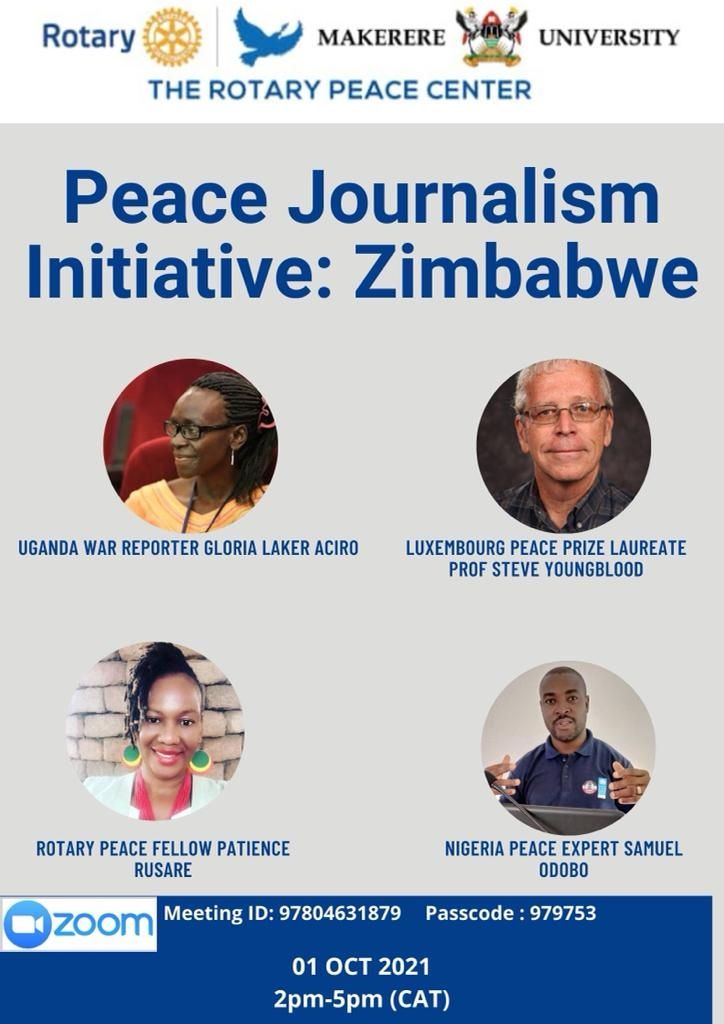
This presentation featured Prof. Samuel Odobo discussing the state of journalism in Nigeria, and the difficulty of practicing peace journalism while sandwiched between a censorship-prone government and the Boko Haram terrorist group, which intimidates and threatens journalists.

The second presenter, Gloria Laker from Uganda, related her extraordinary experiences reporting the LRA war in Northern Uganda. She confessed that some of the reporting about the conflict done by her and her colleagues helped to fuel the war. Laker said she “took it as a personal responsibility” to improve reporting about the conflict. Since the war, Laker has been instrumental in spreading peace journalism in Uganda, including launching the Peace Journalism Foundation and Refugees Online Network. The Zimbabwean participants found her presentation fascinating, and inspiring.

I concluded the session by talking about polarization and peace journalism. I discussed a study by Afrobarometer (disputed by one participant) that Zimbabwe is the most polarized country among those surveyed. I gave examples of media fueling polarization around the world in reporting about politics, civil unrest, and even the pandemic. I closed by discussing how PJ might reduce polarizing Covid coverage. These tips included not intruding on victims or their families; not sensationalizing; giving voice to the voiceless poor and marginalized who have been most impacted by the pandemic; and using real experts (virologists, epidemiologists, public health workers) as sources rather than politicians and faux-experts.

My session today was part of a peace journalism training program sponsored by the Rotary Peace Center at Makerere University in Kampala, Uganda. The project is headed up by Rotary Peace Fellow Patience Rusare. The project will continue with a session November 1, then conclude with a December 1 seminar.


Friday, October 1, 2021

The Peace Journalist magazine has arrived
The October 2021 edition celebrates the magazine’s 20th issue with a study from Dr. Jake Lynch analyzing coverage of peace journalism seminars, as well as reports from Zimbabwe, Spain, India-Pakistan, and elsewhere.

To see the magazine--

View/download PDF- https://tinyurl.com/sxmh7hvv

Issuu- https://tinyurl.com/eh5rstnj

My editor's notebook, on page 3, is pasted below. Thanks for reading!

EDITOR'S NOTEBOOK
As I celebrate 20 issues of The Peace Journalist, I do so amazed and thrilled that the magazine has done what I intended it to do—create a sense of community among peace journalists and PJ academics and students, and provide a forum to disseminate information about our research and projects. I’m gratified as well that articles from The Peace Journalist have been cited in numerous papers, and that the magazine itself has proven a valuable tool for researchers like Dr. Jake Lynch (see page 4).

I am also amazed by the breadth of coverage since that first issue in October 2012. There have been 268 articles in these 20 issues from 67 different countries, literally from Afghanistan to Zimbabwe. An equally amazing 175 different writers have contributed their wisdom to the publication. Special recognition goes to the Five Club—those who have contributed five or more articles to the magazine.
These talented authors are Gloria Laker (Uganda); Vanessa Bassil (Lebanon); and Dr. Jake Lynch (UK/Australia). The Three Club (three articles) includes Monica Curca; Mohid Ifikhar; Innocent Iroaganachi: Kirthi Jayakumar; Mayra Ambrosio Laredo; Masoud Momin; Rosaline Obah; Fredrick Ogenga; Marianne Perez de Fransius; Giuliana Tiripelli; and Alexander Vojvoda.

As we move forward to the next 20 issues, it’s my hope that the magazine can expand and offer more space for your articles, commentaries, and letters from readers. Thank you, dear authors and readers, for your continued support and encouragement.

--Steven Youngblood, editor


Tuesday, September 21, 2021

Celebrating Peace Day
On this most auspicious occasion, International Peace Day, I was thrilled to be invited to speak with my colleagues at Peace Radio in Yemen.

We discussed the importance of peace day, and the potentially significant impact that their work which includes launching a radio station in Yemen called Peace Radio. I shared the words of UN Secretary General Antonio Guterres, who observed that radio, still the dominant media platform worldwide, is a powerful tool for "dialogue, tolerance, and peace." (See article).

I congratulated my colleagues on the launch of Peace Radio, and offered several suggestions, including using their radio platform to empower women and to build bridges between communities and people in Yemen.

Their work is admirable, even brave, considering the desperate circumstances in Yemen. I am proud of my association with Peace Radio. The example set by my Yemeni colleagues inspires me.


Wednesday, September 1, 2021

Rotary Peace Center event targets Zimbabwean journalists
I had a great time today talking with 30 Zimbabwean reporters about peace journalism, and the state of media in their country.

After my presentation about the deficits of traditional reporting and the principles of peace journalism, we held an interesting question and answer session. One theme was repeated several times—the difficulty of practicing any journalism (let alone peace journalism) in a country where media are only partially free.

Zimbabwe is ranked 130th in the world in press freedom, according to Reporters Without Borders (RSF). In their country report, RSF writes that Zimbabwe President Emmerson Mnangagwa “was notorious for suppressing dissent when he was national security minister and his first steps with regard to press freedom have been marked more by promises than anything like the concrete progress for which that journalists had hoped. Access to information has improved and self-censorship has declined, but journalists are still often attacked or arrested.” 

My response, to seek as much incremental change as possible, is always the same when I am teaching in restrictive environments, whether in Zimbabwe, Kuwait, or Sudan. I see peace journalism as an ideal, something to strive for. There are obstacles to PJ in every country, though these vary in number and severity. Even in Zimbabwe, I said, small steps can be taken that reflect peace journalism principles that will be perceived as non-threatening by the government. These PJ steps include giving a voice to the voiceless, leading societal discussions about solutions, rejecting inflammatory language, and offering counternarratives that build bridges between groups, rather than exacerbating societal divisions.

My session today was part of a peace journalism training program sponsored by the Rotary Peace Center at Makerere University in Kampala, Uganda. The project is headed up by Rotary Peace Fellow Patience Rusare. The project will continue until December. My next presentation, on media polarization and PJ, will be Oct. 1.


Friday, August 20, 2021

An email from Afghanistan: Worry, and Hope
I’ve been in touch with a colleague (an academic and journalist) in Afghanistan about the situation there. Ironically, he first contacted me a few weeks ago seeking resource materials on peace journalism. I asked him if he'd answer a few questions, and he gladly consented. For his safety, I am not mentioning his name or city. His revealing comments are below.

Discuss the Talban takeover of your region.
The Taliban came to power in a way no one could have imagined. For example, preparations were made for a fierce battle with the Taliban, but when I woke up in the morning, all my neighbors came out and looked around and said that the police had left the area. About an hour or two later, the Taliban were informed that police and army had left the area, so they came and took power, which was a surprise to all of us. The people were happy that there was no war and the power was transferred without bloodshed and death, but otherwise the people were very sad for their future and the future of Afghanistan.

What is being said about the American withdrawal?
Unfortunately, we may lose these 20 years of achievements. People are very upset with the United States for leaving Afghanistan in a state of instability and for bringing the situation in Afghanistan to a state where no one is able to see his/her future and even can’t imagine a future. And if they bring pressure on the Taliban and they work for the prosperity of Afghanistan, it will be a unique example of good friendship between Afghanistan and the United States.

How is your city different since the Taliban took over?
People have come to work, but not in numbers. It is unknown at this time what they will do after leaving the post.  Based on that, but now there is no significant change and it is not known because they didn’t spend much time and also schools, universities are all off. I would recommend changing this to, "there hasn't been much time since the Taliban took over (my city). But the universities are closed as are the schools. So, it is not clear how much they will bring change. But over time it will become much clearer how much change will come and what that change will be.

And what about the plight of women and girls?
The revelations will also appear over time, as they have now announced that girls will be able to continue their education. But the girls are very fearful (not delusional). And do not want to even leave the house.  For example, my sister in law who used to be the principal of a school now says that she will no longer serve as principal and she will not leave her home. There are thousands of girls who have worked hard for the last 20 years, but now with the advent of the Taliban, they do not have the courage to go outside or the courage to work or study outside the home.

Do you have hope for the future of Afghanistan?
If we look back at their previous control of Afghanistan, and if they employ the same policies as before, we will lose hope and the gains we have made in the past 20 years will be lost. It will be as if we've lost 50 years, half a century of progress. But if over the past 20 years, the Taliban has changed, has learned that peace and not war is the solution for all, then that would be a happy moment and would lead to a better future. But now we can only guess as to their intentions. A few days from now we will have a better idea as to their approach. We can only hope for the best.