Wednesday, June 13, 2012

Diverse group leads to lively discourse

Participants plan, discuss
 This week’s first peace media and counterterrorism seminar in Kampala has brought together an eclectic mix of Ugandans, including journalists and those who work at facilities that might be at-risk for terrorist attacks. These facilities include schools, tourist and wildlife centers, and bar/restaurants. One of the participants represented a bar/club that was bombed by al Shabab extremists in July, 2010.

This was, by any measure, an engaged, energetic group, especially when they formed into teams. In these teams, the participants created a blueprint for a community security committee and produced anti-terrorism public service announcements (click here to listen). Their PSA’s were engaging, smart, and delivered important vigilance messages to the public.
Dr. Ken Christopher--"Get outta here"

Our at-risk facilities seminar was adeptly led by Park University Criminal Justice Professor Dr. Ken Christopher, who was assisted by Park Professor Emeritus Dr. Carol Getty.

Gloria Laker (white shirt) leads production

Like our other US Embassy-Kampala sponsored seminars, it is our hope that this group will continue to collaborate and cooperate in the future on anti-terror messaging.

--Follow our adventures on Twitter @PeaceJourn--


Saturday, June 9, 2012

Hamilton conquers Uganda; next stop India? Pakistan?

If you’d never been out of the U.S., it’s understandable to think that you might be a bit nervous for your first trip to, say, London or Rome. Now, imagine the nerves if that first trip abroad were to Uganda.

Not that there’s anything wrong with Uganda, mind you, but for many who don’t know what a great place Uganda is, a trip there sounds a little scary.

This is precisely the situation faced by my colleague Dr. John Hamilton, a criminal justice professor at Park University who has spent the last three weeks here in Uganda teaching media/counterterrorism seminars with me and my other colleagues Dr. Ken Christopher and Dr. Carol Getty.

John Hamilton (left) with Ken Christopher
I must confess to being a little worried about how John would handle the culture shock. It turns out that he was born for international travel. Even though it was his inaugural trip abroad, John handled everything like an old pro. He was seemingly unaffected by the vicissitudes of travel. Here, those include tedious car rides, bumpy, dusty roads, skipped meals, repetitive lunch buffets, showers with the water pressure of knotted hoses, and 5:00 a.m. wake up calls from annoying roosters.

Not only was John good natured, he was curious about everything, especially the food. He tried kudu (antelope) and ostrich and matooke (steamed plantains—not his favorite). He even tried the “beef” on the lunch buffet at one of our seminars. Also not his favorite. There were lots of things he did like, however, like the local beer (Nile) and the local fish (tilapia).

It was fun for me to watch John (and Carol and Ken) really get into teaching, pouring themselves into lessons and opening themselves up to our students. After one seminar, a participant came up to me and thanked me for “selecting such great teachers to bring with you to Uganda.” I do feel pretty smart for asking them to participate in this project, which is sponsored by the US Embassy-Kampala and the Center for Global Peace Journalism at Park University.

John leaves Sunday and heads back to Kansas City. (Ken, Carol, and I have two more seminars here). Bon voyage, John.

Now that John's a veteran traveler, we'll soon be planning our next overseas project together. I wonder if he's ready for India or Pakistan. I hear Islamabad is lovely this time of year.

(Click here to see John's Uganda blog. For Ken Christopher's blog, click here).

Wednesday, June 6, 2012

Military, journalists set aside hostilities
Dr. Carol Getty in action
To no one’s surprise, the army guys don’t much like the way that the journalists report about them, and the journalists aren’t especially enamored with the way that the army withholds information from reporters.

 This meeting between military and journalists could be taking place at Fort Leavenworth or anywhere else where media mix with soldiers. It just so happens that this particular get-together is in Fort Portal in Western Uganda.

Dr. Ken Christopher
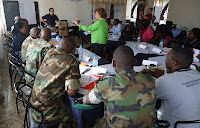
 The meeting—a seminar on peace media and counterterrorism—brought together 21 representatives from media, police, and the army (UPDF-Ugandan Patriotic Defense Forces). The army participants were public information officers and others who interact with the media.

 The exchange between the media reps and security officials was animated on the first day particularly as each side poked at the other’s sore spots: a media that sometimes favors sensationalism over fact-based reporting, and a security force that isn’t as forthcoming as it could be with reporters.

By the third day of the seminar, sponsored by the US Embassy-Kampala and the Center for Global Peace Journalism at Park University, the participants had come together to produce an anti-terror radio PSA and a plan to work together in the future.

 It will be interesting to see if and how the media reps and security folks join forces in the future to combat violent extremism. There was certainly a more formal atmosphere at this seminar (compared to our six other seminars). Participants did speak out, although my colleagues (Carol Getty, Ken Christopher, John Hamilton) and I noticed a reluctance to speak that was not evident at our other seminars. Christopher pointed out that in other seminars he’s taught, participants were sometimes reluctant to speak in front of high ranking individuals, like the UPDF officers and resident district coordinator who were present at this seminar. I think Prof. Christopher's right.

 If nothing else, getting the security officials and reporters in the same room talking to one another, and hearing them acknowledge their shared commitment to keeping Ugandans safe, gives me hope that they will better collaborate in the months ahead.

Radio Active

Prof. John Hamilton on the air in Fort Portal, Uganda
Our stay in Fort Portal included a stint as guests on a talk program on VOT radio. The wide ranging discussion included banter about our seminar as well as more general discussions about government, the right to protest, and women’s rights.

As the show concluded, the host asked me a question about whether Ugandan President Museveni had stayed in office too long. Before I could answer, the producer indicated that time was up. Saved by the bell!

Follow daily updates on our Ugandan adventure on Twitter @PeaceJourn .


Saturday, June 2, 2012

Two peace media/antiterror seminars conclude in Kampala

PSA production with Gloria Laker
 Under the cloud of a terrorist attack in neighboring Kenya (see previous post below), we completed two workshops this week for government/security officials and media. One of their assignments was to produce a public service announcement with an anti-terrorism message. (Click here to listen). These turned out great thanks to hard work and collaboration. Next week, our project, sponsored by the Center for Global Peace Journalism and the U.S. Embassy-Kampala, moves to western Uganda.

Dr.  Carol Getty
Producing anti-terror PSA


Thursday, May 31, 2012

Kenya explosion underscores need for counterterrorism in Uganda

Media-counterterrorism seminar
 We college teachers often worry about making our lessons   relevant.   Thus, we’re always coming up with creative ways to connect what we teach with our students’ lives.

Sometimes, though, the connection is made for us.

Here in Kampala, Uganda, our lesson on peace media and counterterrorism (sponsored by the US Embassy and Center for Global Peace Journalism) is taking on a special urgency this week. This is because neighboring Kenya suffered a terrorist attack a few days ago. A bomb exploded in a crowded marketplace in Nairobi, injuring 33 people. Authorities are still investigating the bombing.


Prof. John Hamilton leads the discussion
It was under the cloud of the Kenyan attack that our seminar participants, journalists and local government officials, teamed up yesterday to create an action plan for collaborating on anti-terrorism projects. Instructors and Park University professors John Hamilton, Ken Christopher, Carol Getty and I were gratified to hear the conciliatory language used by the participants as they described how they planned to cooperate. This congeniality is especially noteworthy given the traditionally adversarial relationship between press and government, particularly here in Uganda. (I elicited laughter with the phrase “Not exactly best friends”.) One group of participants said that media and local leaders should march “hand-in-hand” to combat terrorism, while others pledged cooperation for “a more secure Uganda”.
Media-counterterrorism seminar
 The participants’ ideas on potential collaborations were also well-conceived. These include educating the public about Ugandan anti-terrorism laws, creating pamphlets on how the public can remain vigilant, and arranging briefings for average citizens by security officials. All the while, the press would work with the officials to keep the public aware, informed, and empowered.
Prof. Ken Christopher, right.

Although the professors urged the participants to nurture the anti-terrorism seeds we planted this week, I suspect in hindsight that we really didn’t have to do anything to get the participants engaged. All they have to do is turn on the news or open up the New Vision newspaper and see the banner headline: “Uganda on alert after Kenyan terrorist attack.”